American Gelbvieh Association Releases New Economic Selection Indexes and EPDs
LINCOLN, Neb. – The American Gelbvieh Association (AGA) has released three new economic selection indexes and four new EPDs that are now available to all AGA members and stakeholders.
“AGA is excited to introduce these new selection indexes to commercial cattlemen. They combine relevant traits and applicable pricing information to create tools that will assist producers in finding animals that best fit their ranch profitability model. The new EPDs bolster AGA’s impressive suite of traits that can be implemented by both AGA members and commercial producers using Gelbvieh and Balancer® genetics,” said Harold Bertz, AGA executive director.
Economic Selection Indexes
The new indexes are designed around three common production/marketing scenarios as described below. All three indexes are based on a breeding system where Gelbvieh bulls are mated to Angus-based cows and include selection criteria (EPDs) for economically relevant or key indicator traits. Summary statistics and percentile ranks will be reported through the DigitalBeef portal. Each index has been carefully designed and reviewed, and is described below with its selection criteria. Commercial producers should utilize the selection index whose production scenario most closely matches their production system.
Maternal Profit Index (MPI): In this production scenario, Gelbvieh bulls are mated to Angus-based cows with surplus calves marketed at weaning, with replacement heifers retained from the calf crop. EPDs weighted in this index are Calving Ease Direct (CED) and Maternal (CEM), Weaning Weight (WW), Milk, Mature Weight (MW), Dry Matter Intake (DMI), Stayability (STAY), and Heifer Pregnancy (HP). Mature weight is the primary driver and represents the significant cost of maintenance energy requirement in the cow-calf sector. Weaning Weight and Milk (expressed in pounds of calf weaning weight) represent the principal revenue stream. Stayability helps account for differences in replacement costs in the system and the effect of heifer retention on revenue streams. This index should be used by commercial cattlemen whose production scenario includes the traditional marketing of calves at weaning and replacement retention from the herd.
Feeder Profit Index™ (FPI™): Envisioned as a completely terminal index, FPI assumes all calves are marketed as finished beef carcasses priced on a value-based grid. Thus, it shouldn’t be used in production scenarios where replacements are kept from these matings. The new FPI formulation more precisely weights economically relevant traits available for selection, including the key carcass traits of Carcass Weight (CW), Ribeye Area (REA), and Dry Matter Intake (DMI) that were not included in the original formulation. The new FPI also weights Fat Thickness (FAT), post-weaning Average Daily Gain (ADG), and Calving Ease Direct (CED). Carcass value determined by carcass weight, quality, and yield grade influencing traits accounts for approximately 75% of the index as principal revenue drivers. Dry Matter Intake captures differences in expected costs to the terminal carcass endpoint.
Total Profit Index (TPI): Combining replacement female retention from the herd with carcass endpoint for marketed surplus heifers and all steers, TPI balances both maternal and terminal selection criteria. Because of the challenges faced by commercial cattlemen by the antagonisms in selection for this production scenario, TPI includes the largest and most diverse set of EPDs in the model, including carcass traits as the primary revenue drivers with cow Mature Weight (MW), Stayability (STAY), and Dry Matter Intake (DMI) as cost drivers.
Implementation of the new Gelbvieh indexes into sire selection decisions is simple and straightforward. Each index is reported in dollars and represents the differences of sires’ progeny values when produced under each of the specific scenarios. The index values reported are on a per conceived calf basis. It is expected that users of the indexes generally conform to the respective production circumstances.
The new Gelbvieh-specific selection indexes present an unprecedented opportunity for breeders and commercial cattlemen to select the right bulls for improved profit potential. These tools provide a simple, efficient, and impactful multiple trait selection strategy for producers in each of the common production scenarios.
New EPDs
Mature Weight (MWT): Body weight of cows adjusted to six years of age at body condition score 5. MWT is reported in pounds and is computed from a genetic model that leverages information from weaning weight, post-weaning gain, and mature weights of cows. Reported weights are adjusted for both age at observation and for body condition. Body weights of cows 2 to 12 years of age are utilized in the evaluation, so producers can report data at any age for the evaluation. Preferably, cows should be evaluated at or shortly following weaning, as that’s a convenient time for many producers to process cows. Weights collected at other times in the production cycle are acceptable. Producers should measure full contemporary groups on the same day as the observation date, which helps form the contemporary group.
Cow Energy Requirement-Yearly (CERY): Mature body weight, lactation potential, and birth weight are primary predictors of energy requirements. Mature Weight, Milk, and Birth Weight EPD are utilized to inform prediction equations from beef cow nutrition research to estimate differences in energy requirement over a production year. The CERY EPD is reported in pounds of Total Digestible Nutrients (TDN) required for an age 6 cow.
Dry Matter Intake (DMI): the genetic difference in pounds of expected average daily dry matter intake of progeny.
$GAIN: reports the difference in expected marginal value of gain, less the cost of feed to achieve that gain. Reported in dollars of marginal profit, with more positive values representing increased efficiency and profit.
All AGA members and commercial cattlemen are invited to attend a webinar hosted by Dr. Bob Weaber, AGA genetics consultant, on September 23, 2025, at 7:00 p.m. CST. The webinar will provide more information about each index and EPD, as well as guidance on how to utilize them in various production scenarios. Register for the webinar today at https://us06web.zoom.us/meeting/register/HzC4BuLCQ-q6siX5zA0Dig
The American Gelbvieh Association is a progressive beef cattle breed association representing 1,100 members and approximately 40,000 cows assessed annually in a performance-oriented total herd reporting system.
###






 LINCOLN, Neb. – The American Gelbvieh Association (AGA) is excited to announce the hiring of Sydney Wellsandt, Unadilla, Nebraska, as the AGA fall intern. In her internship, Wellsandt will be assisting in all aspects of AGA operations including member programs and services support, member education, and preparation for the 53rd Annual AGA National Convention and AGA National Show activities.


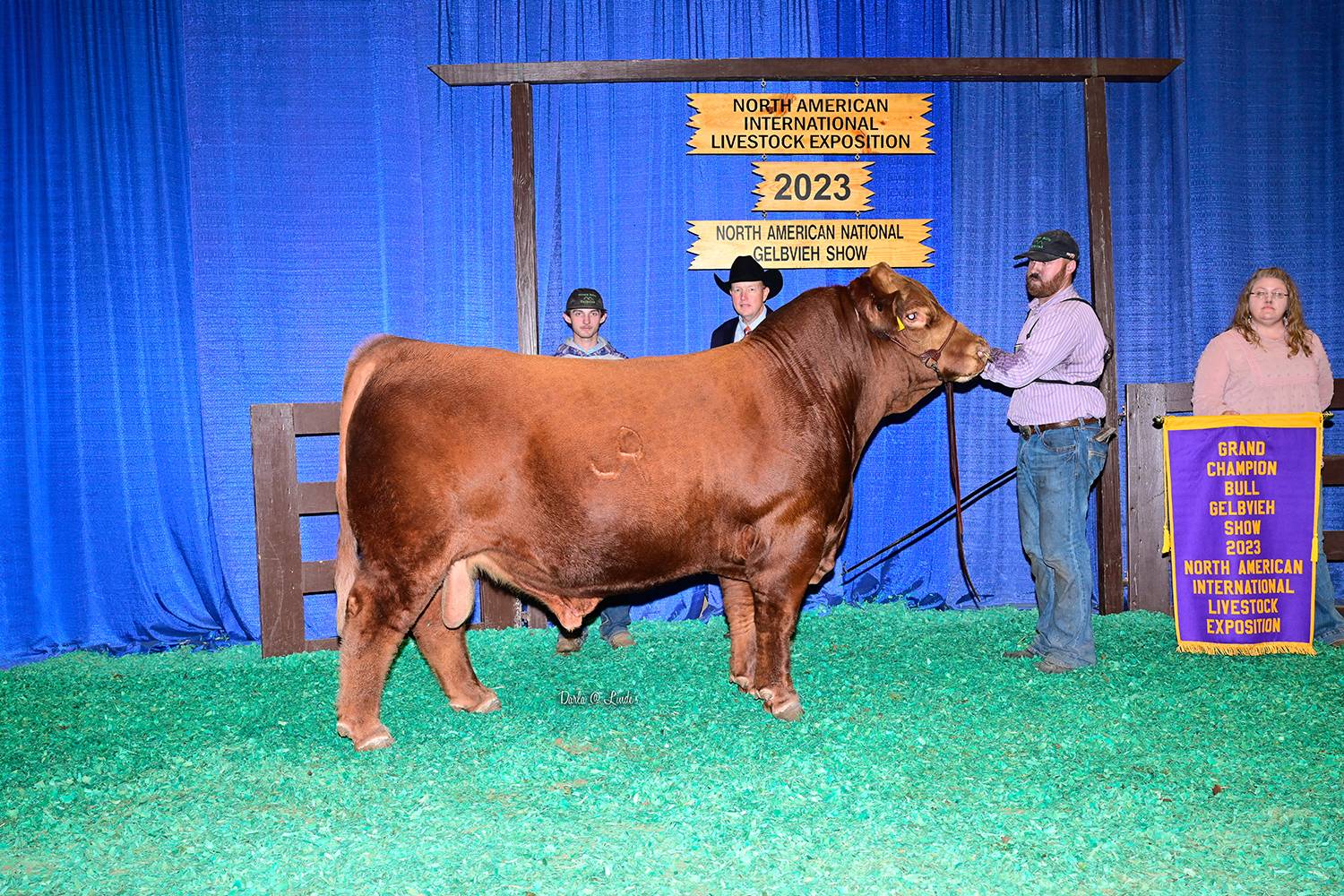
 Grand Champion Gelbvieh Bull was BRAX Mr Kevlar K185 born June 27, 2022, and exhibited by Braxton Murray of Kingfisher, Oklahoma. Sired by GAMP F220, this bull first earned the title of Champion Junior Bull.
 Reserve Grand Champion Gelbvieh Bull was GHSC E-Trade GK56 owned by Gage Hutson Swindler of Braymer, Missouri. Sired by JRI Trade Secret 253G486 and born April 25, 2022, this bull first earned the title of Champion Senior Yearling Bull.
 Grand Champion Gelbvieh Female was BCFG Butlers Ms Jaelynn J534 ET exhibited by Aidan Raab of Markle, Indiana. Sired by JRI General Patton 213B97 and born September 23, 2021, this female first earned the title of Champion Senior Yearling Female.
 Reserve Grand Champion Gelbvieh Female was TGV T Bar S Ms 1166K ET exhibited by Kylie Smith of Decatur, Arkansas. Sired by DLW TPG Frontrunner 2510F, born October 7, 2022, this female first earned the title of Champion Senior Heifer Calf.
 Grand Champion Balancer Bull was CMYB Pure Country 56K owned by Cole Youngblood of Columbia, Kansas. Born December 5, 2022, and sired by TTTT 4T Pure Profit 1808F ET, this bull first earned the title of Champion Senior Bull Calf.
 Reserve Grand Champion Balancer Bull was CWLR Won’t Back Down 210K owned by Corbin Lowe of Winfield, Kansas. Sired by MDR First Step 7549E, born March 10, 2022, this bull first earned the title of Champion Senior Yearling Bull.
 Grand Champion Balancer Female was BCFG Butlers Ms Kesha K549 ET owned by Braylen Schaeffer of Hagerstown, Indiana. Born March 6, 2022, and sired by PVF Blacklist 7007, this female first earned the title of Champion Late Spring Yearling Heifer.
 Reserve Grand Champion Balancer Female was MDR Knock Out 203K owned by Corbin Lowe of Winfield, Kansas. Sired by MDR First Step 7549E, and born March 3, 2022, this female first earned the title of Reserve Grand Champion Late Spring Yearling Heifer.
 LINCOLN, Neb. – The American Gelbvieh Association (AGA) is pleased to announce the hiring of Shianna Bradley to the AGA staff full-time as the office services specialist. In her role, Shianna will assist AGA members and customers with submitting data to the online registry service, create educational resources for AGA members, and work with the DNA department to organize the DNA sample storage library.
 LINCOLN, Neb. – The American Gelbvieh Association (AGA) is pleased to announce the addition of Sarah Dannehl, Wymore, Nebraska, to the AGA staff as the performance programs coordinator. In her role, Dannehl will assist AGA members and customers with the AGA Online Registry Service, support AGA data collection projects, help members with DNA testing questions, and focus on member education efforts.


 LINCOLN, Neb. – The American Gelbvieh Association (AGA) is pleased to announce the addition of Megan Underwood to the AGA staff as the Communications Coordinator. In her role, Underwood will lead the communication efforts of the association, serve as editor and assist with advertising for the AGA’s monthly publications, and assist the marketing team in developing a national advertising campaign.


 On December 4, the American Gelbvieh Association (AGA) presented the 2020 Breeder of the Year award to SEGA Gelbvieh, owned by Steve and Gail Fiolkoski of Pierce, Colorado. The award was presented during the awards banquet, which was held virtually.

 LINCOLN, NE – The American Gelbvieh Association (AGA) is excited to announce the addition of Laura Handke to the AGA publications team, serving as editorial contractor.