Media Releases
American Gelbvieh Association Show Increased Registrations, Membership
Registrations and membership numbers for the American Gelbvieh Association (AGA) were higher at the close of fiscal year 2011-2012 compared to a year ago. Animal registrations increased 6.3 percent, with the total number of animals registered by the Association at 35,831. Adult and junior members were 4 percent higher, with a combined sum of 1,589 adult and junior members.
The breakdown of AGA animal registrations is as follows: Balancer®registrations at 44.7 percent, purebred or fullblood Gelbvieh at 42.3 percent, and making up the remaining 13 percent were Percentage or Hybrid and Southern Balancer® registrations.
The largest growth of the Gelbvieh Association was seen in new adult members, with a 14.1 percent increase. The 2011-2012 fiscal year, which runs from October 1 to September 30, closed with 1,066 adult members. Memberships in the American Gelbvieh Junior Association were up 3 percent, for a total of 523 juniors.
Balancer animals are registered hybrid seedstock with documented pedigrees and EPDs. The breed composition of a Balancer animal is 25 to 75 percent Gelbvieh with the balance Angus or Red Angus. Historically, the purebred population represented approximately 80 percent of all AGA registrations. With an increase of Balancer genetics being used in commercial herds in the past few years, the Association’s data shows Balancer registrations now outnumber purebred Gelbvieh registrations.
Any animal, of any breed or cross, may be recorded using the Hybrid Cattle Recording Service with the AGA. The AGA documents the pedigree, breed composition and calculates performance data and provides EPDs. The Southern Balancer is a Gelbvieh heat tolerant composite with at least 25 percent Gelbvieh and 6.25-50 percent Bos indicus breeding.
“The increase in both registrations and memberships exemplifies the expanding impact of Gelbvieh and Balancer genetics on the seedstock and commercial cow-calf sectors of the beef industry,” said Mark Goes, AGA president. “Cattlemen and women are continuing to recognize the benefits of crossbreeding as a valuable tool to increase their profitability in the beef business. Gelbvieh and Balancer genetics make crossbreeding easy.”
Today, approximately 80 percent of the animals registered are black hided animals. Until 1999, more red hided cattle were registered with the AGA than black hided cattle. Of the animals registered with the Association that year, black hided cattle accounted for 49.5 percent of the registrations; red hided animals made up 41.3 percent. Since then, black hided animals have continued to increase their percentage of the total number of animals registered, representing a growing share of the registrations.
To learn more about how Gelbvieh and Balancer genetics make crossbreeding easy visit www.www.gelbvieh.org or call the American Gelbvieh Association at 303-465-2333.
###
American Gelbvieh Association Hires Jim Gibb as Executive Director

The American Gelbvieh Association is pleased to announce the addition of Dr. Jim Gibb as executive director to the AGA staff. Dr. Gibb lives in Louisville, Colo., and has been hired as the part-time executive director, effective immediately.
Dr. Gibb has a long-standing career in the beef industry working with seedstock and commercial beef producers. His work in the field of genomics and DNA testing has helped breeders and cattlemen identify quality genetics in their herds to help them make sound breeding decisions. Dr. Gibb brings an understanding of breed associations as he has previously worked for the American Polled Hereford Association and the American Gelbvieh Association.
“It is with great pride and inspiration the AGA announces the services of Dr. Jim Gibb in his role as executive director of the Association. Dr. Gibb’s vast accumulated experience working with cattle associations, his wealth of knowledge with regard to genomics and national cattle evaluation, as well as his fond familiarity with Gelbvieh cattle and the American Gelbvieh Association qualifies him as the perfect fit to help propel the Gelbvieh breed and the AGA’s membership into the forefront of the cattle industry,” said Mark Goes, president of the American Gelbvieh Association. “His interpersonal skills and supervisory expertise will enhance and facilitate more effective and efficient performance in the areas of research and breed improvement, administration and promotion for the AGA and its membership.”
The decision to hire an executive director for the AGA was made during the recent August meeting of the Association’s Board of Directors. The Board approved to realign the management of the AGA from the matrix management system to executive director management.
In regards to this decision, President Goes offers these comments: “Along with the diligent efforts towards the recent AGA strategic planning process, the Board of Directors allocated funding for a professional analysis of the matrix management of the AGA as opposed to executive director management. Under the professional advisement of a legal organizational consultant, the AGA Board has opted to proceed with the oversight of an executive director. While the AGA utilized the matrix design for almost three years with success, the efficiency and effectiveness of an executive director surpasses that of a matrix management as applied to a not-for-profit organization such as that of the AGA.”
Dr. Gibb will work out of the AGA headquarters office located in Westminster, Colo., on a part-time basis. For more information on the American Gelbvieh Association, visit www.www.gelbvieh.org or call 303-465-2333.
###
American Gelbvieh Association Creates Commercial, Seedstock Producer Awards
In an effort to recognize the outstanding commercial and seedstock producers involved in the Gelbvieh breed, the American Gelbvieh Association has created the Outstanding Commercial Producer Award and the Outstanding Seedstock Producer Award. Both awards are based off the Beef Improvement Federation awards that are presented annually at the BIF conference.
The AGA will recognize one Outstanding Commercial Producer and one Outstanding Seedstock Producer annually during the Gelbvieh activities at the National Western Stock Show. The recipients of the AGA awards will then be considered for the Association’s nominations for the BIF awards that year.
Plans are underway to present the first of these awards at the 2013 NWSS. State associations are asked to nominate one commercial producer and one seedstock producer they feel is deserving of this recognition. Applications are due December 1.
Applications for the Outstanding Commercial Producer Award and the Outstanding Seedstock Producer Awards can be found at www.www.gelbvieh.org under the Member Programs page under the Membership tab. Applications may also be requested by contacting Jennifer Scharpe, AGA director of communications, at jennifers@gelbvieh.org or 303-465-2333. For questions or more information about the awards, contact Frank Padilla, AGA director of breed promotion at frankp@gelbvieh.org or 303-465-2333.
Increase Efficiencies, Profits with Gelbvieh Crossbreeding
Cow-calf producers crossbreed to increase efficiencies and profits. To see greater maternal benefits in a crossbreeding system, producers are choosing Gelbvieh or Balancer® genetics to use on commercial cows. Cattlemen and feeders recognize the value of crossbred calves as they exhibit heterosis (hybrid vigor) and combine the strengths of the parent breeds.
Heterosis refers to the superiority in performance of the crossbred animal compared to the average of the straight bred parents. Heterosis is typically reported in percentage improvement in the trait of interest. Heterosis results from the increase in the heterozygosity of a crossbred animal’s genetic makeup. Heterozygosity refers to a state where an animal has two different forms of a gene.
The advantages of crossbreeding have not changed. A crossbreeding program offers direct advantages including increased cow productivity and longevity as well as better calf survivability and performance. Producers are finding that a structured crossbreeding system helps them achieve the goals of increasing productivity and reducing production costs.
In doing the math, a planned crossbreeding program adds more than $500 over the life of a crossbred cow. That exceeds $50 per year. With a smaller mature cow size, Gelbvieh females provide genetics for exceptional milk production and extra pounds in calves. Heterosis results in increases in lifetime productivity of approximately one calf and 600 pounds of calf weaning weight over the lifetime of the cow.
Sustained female reproduction in the cow herd directly impacts profitability. The costs associated with development or purchase of replacement females is substantial. Older cows are more productive and will wean heavier calves. Gelbvieh females are proven to stay in the herd longer through stayability EPDs. In a Colorado State University study, the stayability of a five year old Gelbvieh female is 68 percent compared to 52 percent in the Simmental and 58 percent in the Red Angus females.
Cow-calf producers will benefit from the variety of traits Gelbvieh-sired females offer over other major beef breeds. The most recent Meat Animal Research Center (MARC) data study showed Gelbvieh-sired calves with the lowest birth weight of the four major Continental breeds. These calves will also reach puberty at an earlier age, 329 days on average; and produced the most pounds of maternal milk of the seven major beef breeds.
The advantage of a crossbred calf is an increase in calf livability and an increase in growth rate. Calves grow to produce their own offspring, passing on prime genetic traits for generations. MARC research shows that crossbred females are 30 percent more productive over their lifetimes due to increased fertility, calf survivability, increased weaning weights and cow longevity. Research shows the average crossbred female remains in the herd about two years longer than straight bred cows.
“By using the maternal power of a Gelbvieh or Balancer in a crossbreeding program, those females produced will tip the scales with hybrid vigor by efficiently weaning more pounds of calf. Through aggressive selection pressure by Gelbvieh breeders, the breed has improved female stayability, increased calving ease, added carcass weight, while producing more pounds of calf weaned per cow exposed. Sell more pounds of calf at weaning, add value to your replacement females and improve your bottom line with Gelbvieh,” said the American Gelbvieh Association’s Frank Padilla.
The American Gelbvieh Association offers many services to assist in maximizing return on commercial breeder’s investment in Gelbvieh and Balancer bulls and replacement females. Their knowledgeable field staff is ready to assist in all marketing needs.
For cattlemen looking to market bulls, replacement females or feeder cattle, check out the AGA’s free Exchange service, including: Bull Listings, Female Listings, and Feeder Calf Listings. Visit www.www.gelbvieh.org/exchange.html to view current postings or to post a new listing.
Cow-calf producers who use Gelbvieh genetics are eligible to add value to females by marketing them through the Maternal Edge commercial female sales. Please visit www.maternaledge.com for more information.
Brand your Gelbvieh-influenced feeder calves with SmartCross® ear tags. This ear tag tells the buyer he is getting quality and predictability. For more information on SmartCross or any other service, contact the AGA office for more information at 303-465-2333.
###
American Gelbvieh Juniors Elect Leadership
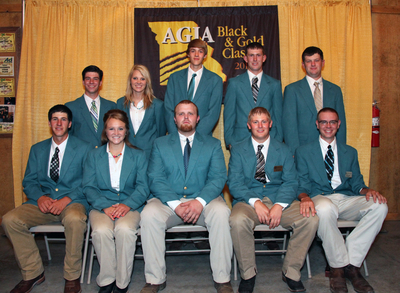
The American Gelbvieh Junior Association (AGJA) held their annual meeting during the 2012 AGJA Black and Gold Classic in Chillicothe, Mo. AGJA members voted to fill four two-year positions with the AGJA Board of Directors for the 2012-2013 term.
Newly elected directors include Nicole Mattison, the daughter of Scott and Sonia Mattison, Lamberton, Minn., Michael Ring, the nephew of Skylar and Annette Martin, Oregon, Ill., and Justin Vehige, the son of Tom and Stacy Vehige, Bonnets Mill, Mo.
Re-elected to a second term on the board was Van Tucker of Portis, Kan., the son of Gregg and Sandi Tucker.
Following the annual meeting, the AGJA Board selected officers for the 2012-2013 term. Presiding will be Dustin Aherin, Phillipsburg, Kan., and serving as vice president is Grace Hammer of Wallace, Kan. Aherin is the son of Dennis and Joyce Aherin. Hammer is the daughter of Lyle and Christy Hammer.
Selected as vice president of leadership development is Garrett Teeter, the son of Walter and Lee Teeter, Mt. Ulla, N.C. Appointed to the secretary position is Van Tucker. Serving as treasurer is Seth Arp of Arlington, Wisc. Arp is the son of Steve and Betty Arp. Cole Buffo, son of Steve Buffo and Anna Buffo of Lansing, Kan., will fill the role of ex-officio. Christian Hojer, the son of Allen and Pam Hojer of Lake Preston, S.D., will continue his term as a director.
The American Gelbvieh Junior Association serves more than 500 members coast to coast, providing leadership opportunities, scholarships and competition. For more information about AGJA, Gelbvieh or AGA services, visit www.www.gelbvieh.org or call 303-465-2333.
Photo caption: These individuals were elected to serve on the American Gelbvieh Junior Association Board of Directors during the junior association’s annual meeting at the 2012 AGJA Black and Gold Classic: (seated from L to R) President Dustin Aherin, Phillipsburg, Kan.; Vice President Grace Hammer, Wallace, Kan.; Vice President of Leadership Garrett Teeter, Mt. Ulla, N.C.; Secretary Van Tucker, Portis, Kan., Treasurer Seth Arp, Arlington, Wisc.; (standing from L to R): Justin Vehige, Bonnets Mill, Mo., Nicole Mattison, Lamberton, Minn., Michael Ring, Oregon, Ill., Christian Hojer, Lake Preston, S.D., and Ex-Officio Cole Buffo, Lansing, Kan.
Kansas Man Inducted into American Gelbvieh Association Hall of Fame
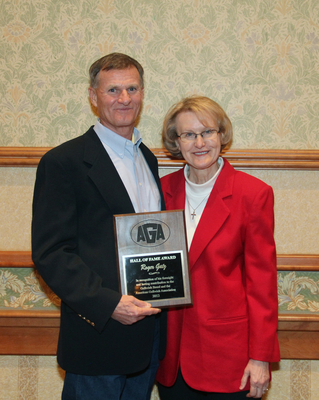
Roger Gatz of Hiawatha, Kan., was the 2012 inductee into the American Gelbvieh Association (AGA) Hall of Fame. Created as a means to recognize those who have made a lasting contribution to the growth and development of the Gelbvieh breed through the influence of the cattle they have bred, breed promotion efforts or leadership provided to the AGA, the prestigious Hall of Fame award is given annually to a deserving individual.
An avid promoter of the Gelbvieh breed and a distinguished list of accomplishments more than qualify Roger to join the nearly 30 other individuals or couples who have a permanent place on the AGA Hall of Fame at the AGA headquarters.
Roger’s 25 years of continued service to the Gelbvieh breed began in 1983 with a publication called “Gelbvieh U.S.” Targeted to commercial cattleman, many Gelbvieh breeders credit the publication with generating interest in using Gelbvieh bulls on predominantly British-based cows in the 1980s. In 1986, Roger began working for the American Gelbvieh Association as a fieldman. Soon after, he helped the AGA produce its first in-house, association-owned publication “Gelbvieh World” in July/August of 1986. Roger has continued to provide his services to the association by providing breed promotion photos, contributing to “Gelbvieh World” ad sales and providing marketing expertise.
In his role as a fieldman, Roger saw a need for a sales management firm within the Gelbvieh breed. In 1988 Roger began Cattleman’s Connection to promote and manage Gelbvieh only sales throughout the U.S. Five years later, Roger expanded Cattleman’s Connection to include semen sales of only Gelbvieh bulls. While business has expanded to include additional breeds, Roger continually promotes Gelbvieh.
When elected to the AGA Board of Directors in 1997, Roger contributed his marketing expertise to co-manage the National Gelbvieh Sale. Two of the three sales he co-managed were the top averaging sales of all breeds during the National Western Stock Show. For the past two years, Roger once again took up the management role and provided his services to manage the National Gelbvieh Sale. With a total gross of $212,000, the average for the 2012 sale was a 20 percent increase over last year’s sale, and a 75 percent increase from the sale two years ago.
Further proof of Roger’s commitment to the American Gelbvieh Association has been his attendance at 24 of the last 25 AGA annual conventions. Moreover, he can make the same claim regarding his attendance at the American Gelbvieh Junior Association’s junior national show held each summer.
Roger is also an active leader outside of the American Gelbvieh Association. He is a member of the Kansas Livestock Association and National Cattlemen’s Beef Association. He is a founding member of the Hiawatha FFA chapter, where he still devotes many hours of his time. As well, Roger is a member of St. Ann’s Catholic Church in Hiawatha where he is also an usher.
In a letter of support for Roger’s nomination into the Hall of Fame, Judd Ranch, Inc., of Pomona, Kan., stated, “Roger Gatz has been the Gelbvieh breed’s number 1 ambassador and promoter for more than 25 years. His cattle knowledge combined with his belief in, and commitment to, the Gelbvieh breed is unparalleled and has influenced numerous individuals to become seedstock producers and an untold number of commercial cattlemen to incorporate Gelbvieh genetics in to their program.”
The American Gelbvieh Association Hall of Fame induction took place during the 2012 AGA “Blazing New Trails” annual convention held January 4-7 in Denver, Colo. Roger Gatz’s contributions, promotion and dedication to the AGA and the Gelbvieh breed are remarkable and deserving of a place in the American Gelbvieh Association Hall of Fame.
###
Photo Caption [2012 AGA Hall of Fame_Roger Gatz with Peg_5518]: Roger Gatz, pictured with his wife Peg, of Hiawatha, Kan., was the 2012 inductee into the American Gelbvieh Association Hall of Fame.