Media Releases
Balancer® – The smart, easy crossbreeding solution
Cow-calf producers utilize crossbreeding to increase efficiency and profits. To see greater maternal benefits in their commercial cow herds, producers are choosing Gelbvieh or Balancer® genetics. Cattlemen and feeders recognize the value of crossbred calves as they exhibit heterosis (hybrid vigor) and combine the strengths of the parent breeds.
Heterosis refers to the superiority in performance of the crossbred animal compared to the average of the straightbred parents. Heterosis is typically reported in percentage improvement in the trait of interest. Heterosis results from the increase in the heterozygosity of a crossbred animal’s genetic makeup.
In the beef industry, use of heterosis to improve production has shown similar advantages to that of hybrid corn in crop production. Numerous research studies have reported up to a 25 percent improvement in pounds of calf weaned per cow exposed when crossbred dams produce crossbred calves. There are three main types of heterosis.
Individual heterosis is the improvement in performance by the individual crossbred animal above the average of its parents. Increases in calf livability, weaning weight, yearling weight and carcass traits are examples of individual heterosis in crossbred calves compared to straightbred calves.
Maternal heterosis leads to the combined improvement in traits from the dam that cause increases in the performance of her and of her progeny. Examples of maternal heterosis include: younger age at puberty, increased calving rate, increased survival of her calf to weaning, longevity, and pounds of calf produced in her lifetime.
Paternal heterosis is the improvement in productive and reproductive characteristics of the bull. Examples of paternal heterosis in a herd sire include: reduced age at puberty, improvements in scrotal circumference, improved sperm concentration, increased pregnancy rate and greater servicing capacity, as well as more years of service.
Crossbreeding combines the strengths of two or more breeds producing offspring with optimum performance levels. As an example, one breed may excel in marbling potential whereas Gelbvieh are superior for red meat yield (cutability), as proven with data collected at MARC. Combining the breed types results in offspring that have desirable levels of both marbling (Quality Grade) and retail yield (Yield Grade). Similarly, milk production and growth rate may be most effectively optimized by crossing two or more breeds.
Utilizing the strengths of two breeds, the American Gelbvieh Association created the Balancer® program. Balancer animals are registered hybrid seedstock with documented pedigrees and EPDs. Balancer cattle are 25-75 percent Gelbvieh with the balance Red Angus or Angus. All polled, Balancer cattle combine the Gelbvieh growth, muscle, retail yield, fertility and unequaled pounds of calf weaned per cow exposed with the marbling of Angus or Red Angus.
Balancer bulls possess paternal heterosis, resulting in improved productive and reproductive traits. The benefits of paternal heterosis include increased servicing capacity, higher pregnancy rate and weaning rate, greater sperm concentration, larger scrotal circumference and reduced age at puberty. Published research proves the reproductive advantages of crossbred bulls. Purebred Gelbvieh bulls used on high percentage Angus or Red Angus commercial cows produce Balancer calves that meet all industry demands from the pasture to the feedyard to the rail.
For producers needing heat tolerant cattle the American Gelbvieh Association offers the Southern Balancer® program. The Southern Balancer combines 6.25-50 percent Bos indicus breeding with at least 25 percent Gelbvieh genetics. This combination produces cattle with superior maternal strengths, market acceptability and environment adaptability.
“At a BIF meeting in 2010, it hardly seems fit to even mention crossbreeding. Commercial producers who have not yet adopted it are a burden to the beef industry,” said Matt Spangler, Beef Genetics Extension Specialist, University of Nebraska. “However, it (crossbreeding) is an excellent example of selection for profitability. We know that the two primary benefits of crossbreeding are complementing the strengths of two or more breeds and heterosis, neither of which create trait maximums. If we think about it simplistically, crossbreeding for a trait like weaning weight leaves us with a calf crop that is better than the average of the parental lines, not better than both parental lines. Crossbreeding, if done correctly, seeks to optimize many traits through complementing breed strengths and produce animals that are better than the average of the parental lines that created them. The best tool that the commercial cattleman ever had is based on optimization, not the production of extremes. So, it would stand to reason that within breed selection should have the same goal, optimums and not maximums.”
###
Impacting the beef business with selection indexes
Providing world-class selection tools to Gelbvieh and Balancer® breeders and their commercial customers is a high priority of the American Gelbvieh Association. Reliable indexes backed by sound science help producers analyze economically relevant traits.
Just over one year ago, the American Gelbvieh Association Board of Directors targeted development of a maternal index as the number one priority in the AGA’s Impacting the Beef BusinessTM long-range strategic plan. This decision was indisputable given that from day one, the Gelbvieh breed has demonstrated its superior maternal characteristics both at research institutions like the U.S. Meat Animal Research Center and across the beef industry. Providing Gelbvieh and Balancer® breeders and their commercial customers with the best possible tool for maternal selection makes great sense.
Why indexes?
Can’t we just continue using individual EPDs and mix and match traits to suite our needs? Certainly, but the power of indexes is that they include multiple traits, weighted by their economic importance. In other words, there is a lot of information and science behind an index that simplifies selection and provides greater assurance of making accurate, long-term selection decisions. Yes, producers could continue to estimate what traits to include in their own selection schemes and speculate on how much emphasis to place on each trait. However, today we have the science and know-how to do much better.
Indexes aren’t new. Early indexes were proposed by two renowned scientists, Drs. Hazel and Lush, nearly 70 years ago and have been used in the poultry and swine industries for the last 20 plus years. Different indexes can have different end-points such as carcass, feeder calf value, feed efficiency and maternal. Indexes may include anywhere from two to as many as a dozen traits and are usually expressed in dollars per head.
The Gelbvieh and Balancer maternal index
Soon after the Board’s decision, the AGA contracted with Dr. Michael MacNeil of Delta Genomics to develop a maternal index. Dr. MacNeil is a geneticist and biometrician with 30 plus years experience at the USDA Livestock and Range Research Station near Miles City, Montana.
The first step was to analyze the AGA database and create EPDs for key components of the index not already in existence. New research EPDs were developed for heifer pregnancy, 30-month pregnancy and mature size. These EPDs were combined with several others including direct and maternal calving ease, weaning weight, milk, stayability and average daily gain to create the prototype maternal index.
The next steps
Association staff is working with Dr. MacNeil and an industry oversight committee to predict the long-term impact of selection using the maternal index. It is anticipated that the new maternal index will make its official debut in the January 2014 AGA Sire Summary. Two additional indexes will also be reviewed by the AGA Industry Oversight and Breed Improvement committees for potential inclusion in the 2014 Sire Summary.
These new indexes, combined with the power of genomic-enhanced EPDs, will provide Gelbvieh and Balancer breeders with world-class selection tools. It’s another example of doing all we can to positively impact our commercial customers and the entire beef business.
###
Gelbvieh Breeders Recognized for Selecting for Maternal Efficiency in Cow Herd
Annually, the American Gelbvieh Association honors females in their Herdbook that exhibit consistent maternal efficiency and stayability through the Dam of Merit and Dam of Distinction program. The AGA credits its members who continue to place selection emphasis on the maternal traits of the breed by being owners or breeders of these outstanding Gelbvieh and Balancer® females.
Of the 39,516 active cows in the AGA Herdbook, only 3.6 percent qualify for Dam of Merit. Only 0.8 percent of all active cows qualify for the Dam of Distinction honors.
“The Gelbvieh breed has long earned the reputation of possessing functional, hard-working females with the ability to breed at a young age, rebreed for the second calf and wean one in that would push down hard on the scale,” comments the American Gelbvieh Association’s Frank Padilla. “The females that qualified for the Dam of Merit and Dam of Distinction program did not achieve such a level of productivity by happenstance. Breeders placed selection pressure on these traits in the development of females that would perform at a level that surpasses others.”
The following is the top ten ranking of states for the combined total of Dams of Merit and Dams of Distinction:
1. Kansas
2. South Dakota
3. Nebraska
4. North Dakota
5. Missouri
6. Montana
7. Arizona
8. Iowa
9. Colorado
10. Minnesota
The Dam of Merit and Dam of Distinction recognition program was started in 1991 to honor the top-notch cows in the breed. The program recognizes two levels of productivity based on data submitted to the American Gelbvieh Association office. A Dam of Merit must have produced at least three calves, while a Dam of Distinction must have produced a minimum of eight calves. Both levels must still meet the strict qualifications requiring breeders to place selection pressure on early puberty and conception, regular calving intervals, and above-average weaning weights.
Gelbvieh and Balancer® females offer maternal superiority and continue to be a wise choice for commercial cow-calf producers. Beef cow stayability is an indication of a bull’s daughters’ ability to enter the breeding herd and remain productive at least until six years of age. Stayability is an economically relevant trait and has a large influence on herd profitability. The costs associated with development or purchase of replacement females is substantial.
A study conducted at Colorado State University evaluated the economic variability of average cow herd stayability. Essentially the study determined that a one unit increase in overall herd stayability resulted in an increase in profit of $2,500 for herds with 40 percent of the cows remaining in the herd to six years of age.
The following lists the top ten breeders of Dams of Merit and Dams of Distinction:
1. Bar T Bar Ranch, Inc., Winslow, Ariz.
2. Judd Ranch, Inc., Pomona, Kan.
3. Lazy TV Ranch, Selby, S.D.
4. Schroeder, Inc., Sioux Falls, S.D.
5. Knoll Crest Farms, Red House, Va.
6. Wehri Gelbvieh, Hebron, N.D.
7. Middle Creek Farms, Bozeman, Mont.
8. Flying H Genetics, Arapahoe, Neb.
9. Post Rock Cattle Co., Barnard, Kan.
10. MLM Gelbvieh, Superior, Neb.
The listing of the top 10 owners of Dams of Merit and Dams of Distinction is as follows:
1. Bar T Bar Ranch, Inc., Winslow, Ariz.
2. Judd Ranch, Inc., Pomona, Kan.
3. Lazy TV Ranch, Selby, S.D.
4. Flying H Genetics, Arapahoe, Neb.
5. Schroeder, Inc., Sioux Falls, S.D.
6. Schafer Farms, Inc., Goodhue, Minn.
7. Middle Creek Farms, Bozeman, Mont.
8. Wehri Gelbvieh, Hebron, N.D.
9. MLM Gelbvieh, Superior, Neb.
10. Knoll Crest Farms, Red House, Va.
###
AGA Board Approves Genetic Conditions Testing Policy
The American Gelbvieh Association Board of Directors has adopted a new genetic conditions testing policy. The complete document containing all policy information can be found on the Genetic Conditions Information page under the Education Center tab at www.www.gelbvieh.org. The core genetic conditions testing policy, effective October 9, 2013, is as follows:
1. All new AI sires and donor females must be tested for AM, NH, CA, DD and OS at the owners expense in order to register progeny.
2. The top 50 sires each year (that have not been previously tested) will be tested for AM, NH, CA, DD and OS at AGA’s expense.
3. Other than points one and two above, there is no additional mandatory testing.
4. On all pedigrees, the animal’s genetic condition status will be designated.
American Gelbvieh Junior Association Selects Ambassadors

Photo caption: (L to R) Carlee Vavra, Nisland, S.D., AGJA Junior Ambassador; Jake Lammers, Lexington, Neb., AGJA Intermediate Ambassador
Two junior members were selected to represent the American Gelbvieh Junior Association (AGJA) as ambassadors. Carlee Vavra, Nisland, S.D., was chosen as the 2013-2014 AGJA Junior Ambassador. Jake Lammers of Lexington, Neb., was named the 2013-2014 AGJA Intermediate Ambassador of the American Gelbvieh Junior Association.
Carlee is the 10 year old daughter of Eve and Brent Vavra and has a true passion and unique enthusiasm for the Gelbvieh breed, making her an outstanding ambassador of the breed.
“I was born a third generation Gelbvieh breeder,” said Carlee. “My first heifer was waiting for me the day I came home. My grandparents gave every grandchild a heifer to start their own herd. I currently have two cow/calf pairs, two heifers and a bull.” Carlee and her older sister Taylor, along with their parents own and operate BV Ranch, which consists of nearly 100 Gelbvieh and Balancer® cow-calf pairs.
Jake is the 14 year old son of Rick and Karri Lammers. He is involved in his family’s diversified farm and livestock operation, and has been an active member of the AGJA and the Junior Gelbvieh Association in Nebraska (GAIN).
“Raising cattle is in my blood; that’s why I have always dreamed about owning my own herd of 100 head of cows. Gelbvieh and Balancer cattle have been a part of my whole life,” said Jake.
Jake’s herd currently consists of 15 Gelbvieh and Balancer cows, both red and black genetics. By retaining most of the heifer calves born each year, he is able to build towards that goal of owning 100 cows.
The ambassador competition was held during the AGJA national junior show the “Northern Lights Classic” held June 30 through July 5 in Rochester, Minn. The AGJA ambassador program has two age divisions. The Junior Ambassador must be eight to 11 years of age. The Intermediate Ambassador must be 12 to 15 years old.
The AGJA created the ambassador program to encourage youth involvement in the breed’s activities. The ambassadors represent the AGJA at Gelbvieh functions throughout the year including Gelbvieh and Balancer shows held at the North American International Livestock Exposition and the National Western Stock Show, along with many state fairs and other events.
“The role of the AGJA ambassadors is to carry the Gelbvieh message to others and spread the word about our junior programs,” said Dana Stewart, AGJA staff advisor and American Gelbvieh Association director of member services.
The ambassador candidates are judged on their notebook, an oral interview, a speech given at the AGJA annual meeting and overall conduct during the annual junior national show. The notebook includes information and photographs on activities, awards and organizations as well as an essay on the candidate’s background and experiences with the Gelbvieh breed. A committee is appointed to conduct the interviews and select the AGJA Junior and Intermediate Ambassadors.
Carlee is a member of the American Gelbvieh Junior Association, the American Legion Auxiliary, and Butte County 4-H. She attends Belle Fourche elementary where she has been on the honor roll, the student council, and has been named student of the month.
“I started helping my grandparents at their annual bull sale by visiting with people about Gelbvieh. I really like to share what I know about the breed. I am not shy when it comes to promoting the Gelbvieh breed with everyone who is willing to listen and see for themselves,” added Carlee.
Jake has been very active within the state and national junior Gelbvieh associations since 2009. He has been a member of two champion junior quiz bowl teams at junior national shows. He won the 2009 GAIN rookie of the year, and in 2012 was named premier exhibitor at the Nebraska State Fair.
“Being a member of the Gelbvieh Association in Nebraska has allowed me the opportunity to organize and hold four semen auctions. In the last four years, these semen auctions have raised over $10,000 to help fund programs and activities for our Nebraska junior Gelbvieh association,” Jake said.
The American Gelbvieh Junior Association serves more than 500 members nationally. The vision of the AGJA is to unify, educate, and develop leaders of the beef industry. To learn more about Gelbvieh or the American Gelbvieh Junior Association visit www.www.gelbvieh.org or call 303-465-2333.
American Gelbvieh Junior Association Elects Board of Directors
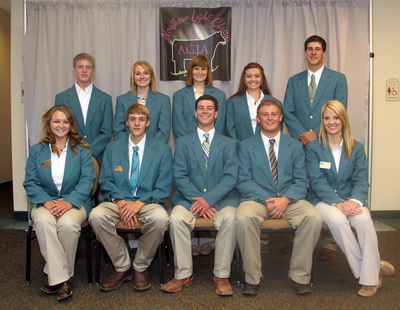
Photo Caption: (Seated from L to R) President Grace Hammer, Wallace, Kan.; Vice President Michael Ring, Oregon, Ill.; Vice President of Leadership Development Justin Vehige, Bonnets Mill, Mo.; Secretary Van Tucker, Portis, Kan.; Treasurer Nicole Mattison, Lamberton, Minn.; (Standing from L to R) Carter Mitchell, Appleton City, Mo.; Kelsey Sheeley, Hillsboro, Ohio; Sydney Bigger, Media, Ill.; Tiana Garcia, Las Animas, Colo.; and Ex-Officio Dustin Aherin, Phillipsburg, Kan.
The American Gelbvieh Junior Association elected five members to serve on their Board of Directors for the 2013-2014 year. Officers for the coming year were also selected. The elections took place at the AGJA national junior show held in early July in Rochester, Minn.
The AGJA Board of Directors consists of nine junior members and one ex-officio member. Directors serve two-year terms and must be 16 years of age as of January 1, and my not have reached his or her 20th birthday as of January 1.
Newly elected directors are: Sydney Bigger, Media, Ill., daughter of Barry and Jody Bigger; Tiana Garcia, Las Animas, Colo., daughter of Keith and Teresa Garcia; Carter Mitchell, Appleton City, Mo., son of Kevin and Debbie Mitchell; and Kelsey Sheeley, Hillsboro, Ohio, daughter of Tim and Karen Sheeley.
Re-elected to a second term was Grace Hammer, Wallace, Kan., the daughter of Lyle and Christy Hammer.
Hammer was then elected the 31st president of the American Gelbvieh Junior Association. Serving as vice president for the 2013-2014 year is Michael Ring, Oregon, Ill., the nephew of Skylar and Annette Martin.
Elected as vice president of leadership development is Justin Vehige, Bonnets Mill, Mo., the son of Tom and Stacy Vehige. Van Tucker, Portis, Kan., son of Gregg and Sandi Tucker, will serve as the Association’s secretary. Voted to the treasurer’s position is Nicole Mattison, Lamberton, Minn., daughter of Scott and Sonia Mattison.
Dustin Aherin, Phillipsburg, Kan., will continue to serve on the AGJA Board of Directors as ex-offico. Dustin is the son of Dennis and Joyce Aherin and recently completed two years as the AGJA president.
“We belong to a strong association that generates the future of the Gelbvieh breed and the beef industry. It can be one of the most influential activities you ever partake in. I know it is for me,” said Aherin. “The enjoyment found in helping the younger kids, and the fulfilling sense of accomplishment from playing a role in the success of an entire week [of a junior national show] can hardly be matched.”
The American Gelbvieh Junior Association serves more than 500 members nationally. The vision of the AGJA is to unify, educate, and develop leaders of the beef industry. To learn more about Gelbvieh or the American Gelbvieh Junior Association visit www.www.gelbvieh.org or call 303-465-2333.