Media Releases
Jeanette Rankin Inducted into Gelbvieh Hall of Fame
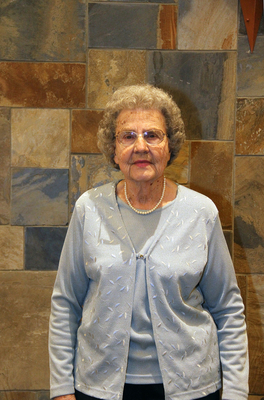
Photo caption: Jeanette Rankin of Kicking Horse Ranch in Oilmont, Mont., was a 2014 American Gelbvieh Association Hall of Fame inductee.
Jeanette Rankin of Kicking Horse Ranch in Oilmont, Mont., was one of two inductees into the American Gelbvieh Association Hall of Fame for 2014. The induction took place on Saturday, January 11 during the AGA’s Impacting the Beef Business: It Starts with Membership Annual Convention. The second inductee was Eldon and Kathy Starr of Stapleton, Neb.
The purpose of the Hall of Fame is to recognize individuals for their lasting contribution to the growth and development of the Gelbvieh breed. That contribution is through the influence of the cattle they have bred, their breed promotion efforts, and the leadership provided to the AGA.
Kicking Horse Ranch has been raising Gelbvieh cattle on their north central Montana ranch since 1973, and they have been lifetime members of the American Gelbvieh Association since 1974. The ranch is located in the Sweet Grass Hills just a few miles from the Canadian border, making it ideal conditions for a cow-calf operation. The herd currently consists of about 60 registered Gelbvieh cows, and at one point was well over 100 registered females.
Rankin was instrumental in the growth and development of the Gelbvieh breed in the United States. During the 1970s and 80s, Jeanette visited Canada and Germany to evaluate Gelbvieh fullblood animals. The Gelbvieh breed originated in Germany and was imported to the United States primarily through Canada.
Naturally a horned breed, Kicking Horse Ranch bred one of the first polled Gelbvieh bulls, KHR Polled Hockeye 07T. He is a polled, red, purebred Gelbvieh bull born in 1985. ABS purchased the bull and made him part of his sire line-up. Today, there are more than 2,400 progeny of KHR Polled Hockeye 07T in the Gelbvieh herdbook, which further demonstrates this bull’s genetic influence on the Gelbvieh breed.
Kicking Horse Ranch held their first production sale in 1983, and they have produced many nationally recognized bulls and females. The 2014 sale will be held March 20 at Western Livestock Auction in Great Falls, Mont. Kicking Horse Ranch has also marketed bulls through the Midland Bull Test, with their bulls earning top performance honors in the test.
Rankin has also been active in the Montana Gelbvieh Association. She has served on their Board of Directors and has assisted with their newsletter for many years.
Nominated for this honor by the Montana Gelbvieh Association, the American Gelbvieh Association recognizes Jeanette Rankin as one of its 2014 Hall of Fame inductees. To watch Jeanette’s Hall of Fame presentation video, visit www.www.gelbvieh.org.
XA Cattle Named AGA Outstanding Commercial Producer

Photo caption: The 2014 American Gelbvieh Association Outstanding Commercial Producer award was awarded to XA Cattle, Levi, Bill and Marie Farr (pictured left to right) of Moorefield, Neb.
In an effort to recognize outstanding commercial producers involved in the Gelbvieh breed, the American Gelbvieh Association has created the Outstanding Commercial Producer award. The award is based off the Beef Improvement Federation award that is presented annually at the BIF conference. The AGA recognized one outstanding commercial producer during the Gelbvieh activities at the National Western Stock Show.
State associations were asked to nominate one commercial producer from their respective states they feel deserving of this recognition.
The 2014 American Gelbvieh Association Outstanding Commercial Producer Award was presented to XA Cattle, Bill, Marie and Levi Farr. XA Cattle is located in south central Lincoln County near Moorefield, Nebraska.
XA Cattle consists of 700 Balancer® cows and farms 2,000 acres of dry and irrigated corn, soybeans, and wheat. The heifers start calving in February and the cows the end of March. In November cattle are pulled out of the hills and the calves are weaned. The calves are backgrounded then sold the end of February or the first week of March weighing 875 pounds. XA consistently sells at the top of the market with feeder cattle going to repeat buyers.
Heifer replacements are selected and developed at the ranch for breeding. A strong emphasis is placed on reproduction with cows being restricted and selected to calve in a short calving season. This selection pressure has paid off as 85 percent of the cow herd calves in the first 45 days of the calving season.
The American Gelbvieh Association congratulates XA Cattle, Bill, Marie and Levi Farr for being the 2014 American Gelbvieh Association commercial producer award winner. They were nominated by GAIN, the Gelbvieh Association In Nebraska for this award.
Gelbvieh Association Inducts Nebraska Couple into Hall of Fame
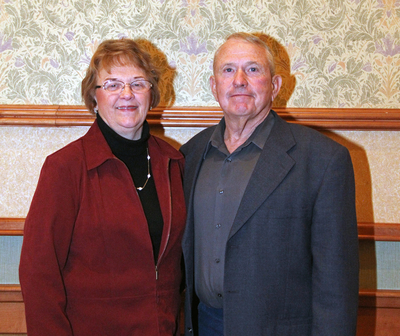
Photo caption: Kathy and Eldon Starr of Cedar Top Ranch and Bull Barn Genetics in Stapleton, Neb., were inducted into the American Gelbvieh Association Hall of Fame on January 11, 2014.
Eldon and Kathy Starr of Stapleton, Neb., were one of two inductees into the American Gelbvieh Association Hall of Fame for 2014. The induction took place on Saturday, January 11 during the AGA’s Impacting the Beef Business: It Starts with Membership Annual Convention. The second inductee was Jeanette Rankin of Oilmont, Mont.
The purpose of the Hall of Fame is to recognize individuals for their lasting contribution to the growth and development of the Gelbvieh breed. That contribution is through the influence of the cattle they have bred, their breed promotion efforts, and the leadership provided to the AGA.
Eldon and Kathy, along with their family, own and operate Cedar Top Ranch and Bull Barn Genetics. Cedar Top Ranch is a large scale seedstock and commercial cow-calf operation located in the Nebraska Sandhills. Approximately one-third of the herd is registered Gelbvieh, Balancer®, Angus and Red Angus cows. The other two-thirds are Gelbvieh-influenced commercial cows. The ranch has been in business since 1938.
Cedar Top Ranch started in the Hereford business. In the early 1970s, Gelbvieh genetics were incorporated and since then the herd has developed to have a Gelbvieh-influenced based. In 1974, Cedar Top Ranch joined the American Gelbvieh Association, of which they are lifetime members.
The Starrs appreciated the maternal traits of the Gelbvieh breed including milking ability, growth, fertility and docility. Their commercial and registered cattle are all managed together, in the tough, unforgiving country of the Nebraska Sandhills. When speaking about the Cedar Top Ranch business, Scott Starr, Eldon and Kathy’s son states, “In the end, it is about selling grass. We need to identify those cattle that convert grass to pounds; that is what makes a guy money! Our job is to put together cattle with the genetics and conformation to get the job done.”
A production year on the ranch begins with calving in May and June. All cows are artificially inseminated once, synchronizing 500 cows a week. After grazing for the summer, the calves are weaned in November, and then run out with just range and cake. Steers and bulls are separated to graze as yearlings. For the last ten years, Cedar Top Ranch has topped the feeder calf market of Superior Livestock, selling yearlings weighing 850 to 950 pounds. Bulls are sold in their annual production sale in Burwell, Neb. This year they will sell 175 coming two-year-old bulls on February 18, 2014.
Bull Barn Genetics is an AI semen company with the most powerful, complete and comprehensive list of Angus, Charolais, Gelbvieh, Hereford, Club Calf, Shorthorn, and Simmental bulls used in the AI industry. Kathy explains that Eldon started Bull Barn Genetics because, “He vowed that he would help the common man breed good cattle and no salesman was ever going to tell somebody that a bull was good when he wasn’t.” Gelbvieh Bull Barn was started when Eldon purchased the entire Gelbvieh semen inventory of Carnation Genetics, who was the first marketer of Gelbvieh semen in the United States.
The list of accolades for Eldon and Kathy could go on. Nominated for this honor by the Gelbvieh Association in Nebraska, the American Gelbvieh Association recognizes Eldon and Kathy Starr as one of its 2014 Hall of Fame inductees. To watch the Starrs’ Hall of Fame presentation video, visit www.www.gelbvieh.org.
Calving season – Time to evaluate udder soundness
Cow-calf producers should consider udder soundness as an economically relevant trait translating to the life or death of a newborn calf. The simple process of taking udder scores will improve overall udder soundness in your cow herd.
For the beef cow, udder quality and soundness usually get lumped in a category called convenience traits, along with others including temperament and feed and leg soundness. While all of these traits have the potential for economic impact to a cow’s productivity, at calving time poor udder quality may translate to life and death of a newborn calf.
Calves that have a difficult time nursing and do not receive adequate colostrum may, at worse, not survive and at best have a higher incidence of scours and decreased immunity levels. Ultimately performance is affected which translates into reduced pounds at weaning and reduced profitability of the cow overall. The impact on performance, on top of the labor costs that can be occurred managing those cows that need help getting a calf to nurse should be considered as additional incentive to include this process in your calving rituals.
Udder scoring at calving is a tool that, while more widespread in the dairy industry, has been shown to improve udder quality in beef females. Research has shown that udder quality is moderately heritable. Which means that over time improvement can be made with selection for this trait.
The Beef Improvement Federation (BIF) adopted an udder scoring system which provides a tool for both commercial and seedstock producers to score both teat size and suspension on a scale of 1 – 9 with a 9 being ideal. Scoring cows within 24-48 hours of calving is the recommended time for evaluating these females.
Where do the most problems commonly lie? Canadian research shows that cows with more desirable teat scores had calves that nursed sooner after birth. Larger teat circumference usually caused more problems than teat length. Short to medium length teats are preferred over long teats. Oversized teats that did not get milked out had a higher incidence of mastitis.
Udder suspension is equally important to udder soundness. Udders that are well attached are less susceptible to injury than the very pendulous poorly attached udders. As well, udders with poor suspension are more susceptible to contamination from fecal material or mud.
Pigmentation is not a factor in the udder scoring system, however should be a consideration for cow-calf producers. A darker pigmented udder will be protected from sunburn or reflection of sunlight from snow.
One other tool that can be used in sire selection for the udder soundness component is the American Gelbvieh Association’s stayability EPD. While many factors are included in this EPD, udder soundness can be attributed to a female’s ability to still be in the herd at age six. Sires with higher stayability can be assumed to have average or better udder quality.
It can be said that cows with poor udders are definitely not convenient when it comes to calving in the cold days of late January and February. As such an evaluation of udder soundness throughout the cow herd may prove to be a sound practice to help insure less calving and calf survival challenges in the future.
Gelbvieh Breeders Recognized for Superior Females
Each fall the American Gelbvieh Association (AGA) honors females in the herdbook that display maternal superiority through the Dam of Merit and Dam of Distinction program. The AGA praises those members who continually place emphasis on the maternal traits of Gelbvieh and Balancer® genetics in their herd and produce these outstanding females.
Of the 40,132 active cows in the AGA herdbook, only 5.0 percent qualified for the Dam of Merit award. Only 1.0 percent of the cows within the herdbook qualified for the elite Dam of Distinction honor. All three of these numbers are up from only a year ago, when the AGA saw 39,516 active cows, 3.6 percent qualifying for Dam of Merit and 0.8 percent for Dam of Distinction.
"Maternal traits are where the Gelbvieh breed really excels. Encouraging our members to continue putting selection pressure on these traits will put the breed in an even better position for impacting the beef industry," says Susan Willmon, American Gelbvieh Association's director of breed improvement.
The Dam of Merit and Dam of Distinction recognition program was started in 1991 to honor superior females within the breed. Both of these honor females based on data that is submitted to the AGA. The females must meet the following criteria to qualify for this recognition: early puberty and conception, regular calving intervals, and above-average weaning weights on their calves. Dams of Merit must have produced at least three calves in addition to meeting these criteria. Dams of Distinction must have produced eight calves or more and exhibit superior, long-term productivity.
Gelbvieh and Balancer females offer a maternal advantage through increased longevity, added fertility, and more pounds of calve weaned per cow exposed. With maternal productivity playing a major role in profitable beef production, Gelbvieh and Balancer cattle are a smart choice for commercial cattlemen, particularly for the advantages of crossbreeding. Using Gelbvieh and Balancer genetics in a crossbreeding program can add as much as $1,000 profit over the lifetime of a crossbred cow.
The following lists the top ten breeders of Dams of Merit and Dams of Distinction:
1. Judd Ranch, Inc., Pomona, Kan.
2. Bar T Bar Ranch, Inc., Winslow, Ariz.
3. Lazy TV Ranch, Selby, S.D.
4. Taubenheim Gelbvieh, Amherst, Neb.
5. Flying H Genetics, Arapahoe, Neb.
6. Schroeder, Inc., Sioux Falls, S.D.
7. Wehri Gelbvieh, Hebron, N.D.
8. Post Rock Cattle Co., Barnard, Kan.
9. Chimney Butte Ranch, Mandan, N.D.
10. Diamond D Gelbvieh, Mandan, N.D.
The listing of the top ten owners of Dams of Merit and Dams of Distinction:
1. Judd Ranch, Inc., Pomona, Kan.
2. Bar T Bar Ranch, Inc., Winslow, Ariz.
3. Lazy TV Ranch, Selby, S.D.
4. Taubenheim Gelbvieh, Amherst, Neb.
5. Flying H Genetics, Arapahoe, Neb.
6. Schroeder, Inc., Sioux Falls, S.D.
7. Wehri Gelbvieh, Hebron, N.D.
8. Diamond D Gelbvieh, Mandan, N.D.
9. Chimney Butte Ranch, Mandan, N.D.
10. Sandy Knoll Farm, Saint John, Kan.
For more information on the maternal benefits of Gelbvieh and Balancer cattle visit www.www.gelbvieh.org or call 303-465-2333.
###
Capture Value in Marketing Feeder Calves
As the time for marketing feeder calves approaches there are several things to consider when getting ready to sell these calves to ensure the most value is received for them.
Overall health of the animals is very important and documented health protocols are important to the buyer who is purchasing the feeder cattle.
"Documented vaccination protocols deliver buyer confidence in the product they are buying," says Clint Berry, Allied Genetic Resources, Superior Livestock, when talking about profit drivers from a seller's standpoint.
He also emphasizes that trusted genetics are important for feeder cattle buyers. Having a trusted and reputable seedstock provider is critical to any commercial operation. The genetics that are being purchased from these seedstock producers should be proven in values such as carcass merit, ability to gain and grade.
Berry also states, "Reputation of your seedstock provider plays in the reputation of you marketing feeder cattle."
When placed in a feed yard, it is essential that cattle are healthy, grow quickly and grade well. When marketing feeder cattle it is important that these things are emphasized and appealing to buyers.
"Most of the grids are driven by grade, more than they are other factors and quality grade matters a lot in terms of getting premiums on the grid," says Tom Brink, former senior vice president and chief risk officer of JBS-Five Rivers Cattle Company.
According to Dan Dorn of Decatur County Feed Yard, the major profit drivers of a feed yard are feed efficiency, carcass merit and carcass weight. Regardless of who is going to be feeding out the calves, downstream value should be created, starting with quality cow herd genetics that incorporate these traits. Decatur County Feed Yard has seen up to a $300 difference in feeder value for cattle that have more profitable genetics.
Once buyers see how calves perform year after year they will be more aggressive in buying the calves, if they performed well. Berry describes that through building a reputation in the marketplace, and developing cattle that consistently perform, buyers will be enticed to compete for these calves and push them to the top of the market or higher.
"Heterosis is key," says Dorn, "You see so much better performance on the cattle, you see better grade typically, more muscle, feed efficiency is better, and so it hits all of the profit drivers."
Heterosis is the increased performance of the offspring when crossing two different breeds. This offers several advantages in a commercial setting, such as superiority in traits important to cattle feeding profitability, when compared to purebred animals. These crossbred cattle drive profit through efficiency, grade and gain. This value can easily be added by using Gelbvieh or Balancer® genetics in a crossbreeding system.
Participating in programs such as source verified and natural can also help capture a premium when selling feeder calves.
"Do as many of the programs as you feel you can and make it work. The more you do the more you are going to get out them," says Jerry Warren, Superior Livestock Representative. "Programs help identify the value of cattle," which in the end is how profit is made.
Warren also suggests joining together with neighbors to put together a load of cattle that are similar in size and age. This can help to make feeder calves more appealing to a larger number of buyers.
Visit the American Gelbvieh Association website at www.www.gelbvieh.org to see how crossbreeding can work for you and for more information about marketing feeder calves, or contact AGA representative Frank Padilla at 303-465-2333.
###